
Commands
A Command is a durable issue an agent flags for the Executor.
What the Commands page shows
The Commands page is dashboard /decisions and CLI aiur commands.
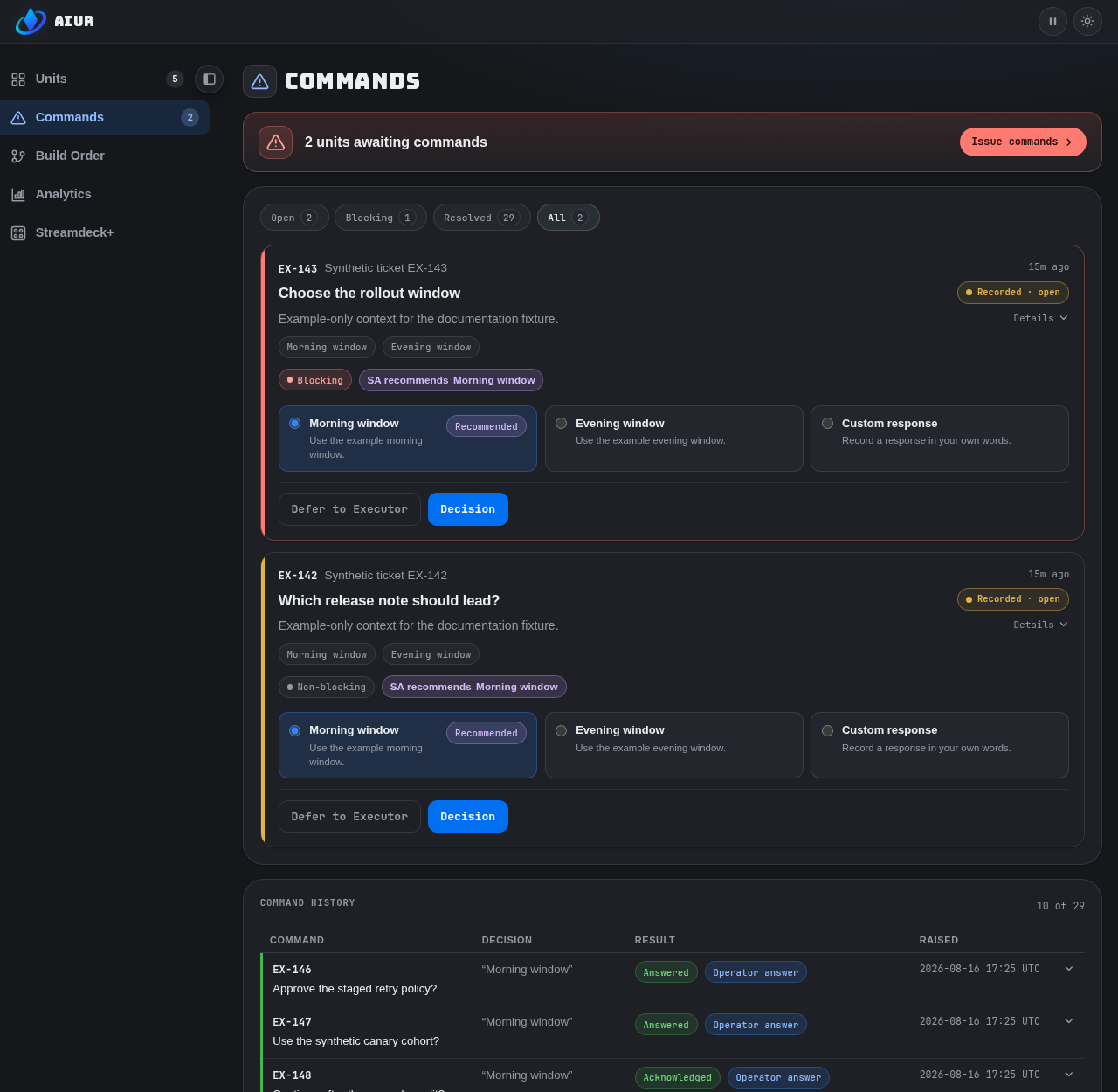
| Field | Meaning |
|---|---|
| Ticket and source | Work and agent that raised the Command. |
| Urgency and authority | How quickly it matters and who may answer. |
| Options and recommendation | Bounded outcomes with the agent's preferred choice. |
| Lifecycle | Open, answered, delivered, acknowledged, resolved, or superseded. |
Executor responses
| Response | Result |
|---|---|
| Answer directly | Pick an option or write a bounded response and send it to the agent. |
| Defer | Leave the Command for a designated Executor agent to investigate and decide. |
| Revise | Append a corrected action without rewriting the original record. |
Authority and attention signals
Agents classify the action, not the subsystem around it. Routine, reversible operational choices should use supervisor_allowed; irreversible actions, spend, external publication, and product direction remain human_required. The Executor can answer only a Command that declares supervisor_allowed or supervisor_preferred together with reversible.
Classification is consequence-based and defaults delegable: a Command that omits authority/reversibility is treated as supervisor_allowed + reversible, so reversible engineering calls reach the Executor instead of parking an agent until an operator appears.
Known Command types carry an explicit policy (src/lib/aiur/decision_command_type.ex): a re-review request (kind: "rework_review") classifies supervisor_preferred + reversible, a PR/ticket sequencing question (kind: "sequencing") classifies supervisor_allowed + reversible, and pre-OCC legacy_attention projections stay human_required.
Because omission defaults to the Executor floor, a Command that is genuinely irreversible, involves spend or external publication, or changes product direction must declare authority: human_required (and the matching reversibility) explicitly.
Aiur warns when a human-required Command is reversible and all of its options are low-risk. It also raises attention when a blocking Command remains unanswered for a day, or when an Executor-unanswerable Command expires without a decision. These signals expose stale context and upstream misclassification; they do not weaken the answer-authorization floor.
Deferred Commands remain visible in the Open and Blocking dashboard counts until they are answered or retired. Their cards show both the deferred lifecycle and the age of the outstanding Command.
Durability
| Contract | Why it matters |
|---|---|
| ID and version | Scope every answer and revision. |
| Action ID | Correlates delivery, acknowledgement, and resolution. |
| Append-only revision | Preserves what the Executor previously decided. |
| Shared projection | Dashboard and CLI read the same durable record. |
See Message Bus decisions for the event path.